
Magnetic settlement gauge (BRE): what it is
The magnetic settlement gauge, also known as the BRE (British Research Establishment) settlement gauge, is a manual measurement device designed to monitor ground settlements at different depths, enabling detailed analysis of deformation distribution along a vertical profile.
How it works
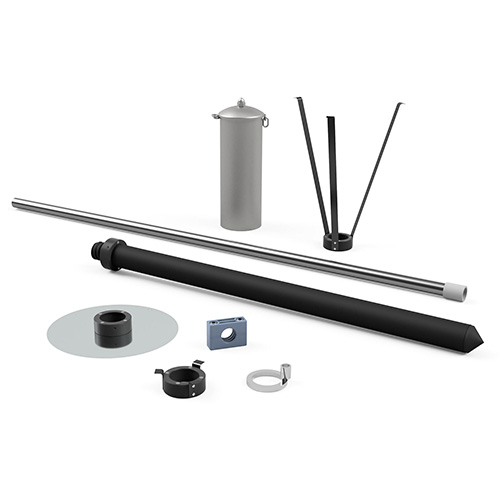
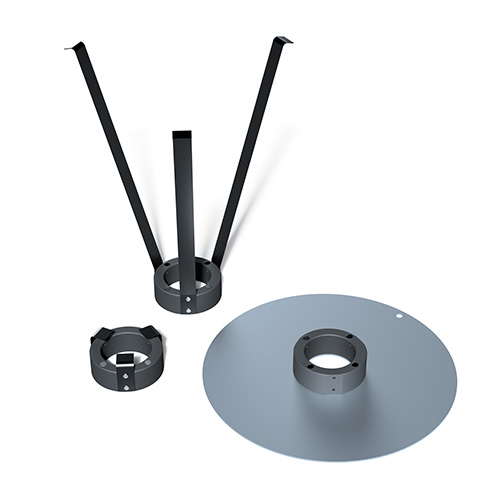
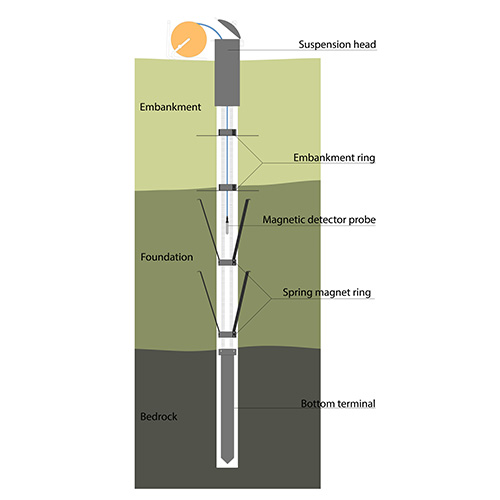
The instrument consists of a settlement column made of a guide pipe installed in the ground, isolated from frictional effects by an external, highly deformable corrugated sleeve, and a series of measurement points (magnetic rings) positioned at defined depths. The rings, bonded to the surrounding soil, follow ground movements and allow determination of both local settlements between two levels and total settlement relative to a stable reference point.
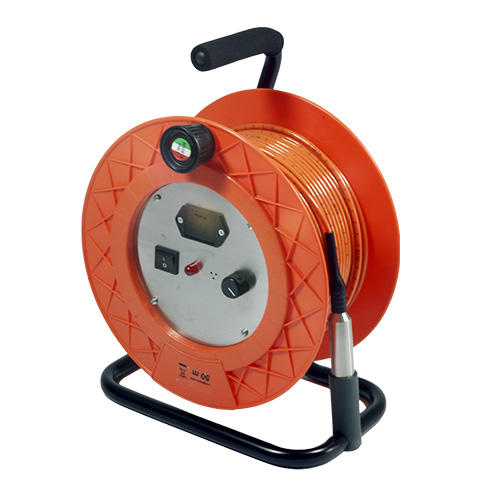
Measurements are carried out using a portable probe equipped with a graduated measuring tape that detects the position of the magnetic targets installed along the guide pipe. The instrument therefore allows the full vertical displacement profile to be obtained over time, providing essential information for evaluating soil behaviour and soil-structure interaction.
Applications and benefits
Thanks to its simple design and high reliability, the magnetic settlement gauge is an effective and cost-efficient solution for manual geotechnical monitoring. The possibility of installation in boreholes or embankments, together with the use of different ring types (spring or plate), ensures high application flexibility for both vertical and horizontal installations.
The instrument is particularly suitable for monitoring settlements in compressible soils and for assessing deformation induced by loading, enabling the determination of both cumulative and differential displacements along the vertical axis.